
Table of Contents
If you hold a rental in your own name, every claim that arises on it is a claim against you. A tenant's injury, a contractor's lien or an unpaid judgment reaches your home, your savings and every other property you own. Held in an LLC for rental property, the same claim reaches the property and the LLC's account and stops there. For an investor building a portfolio, that separation is the difference between one bad year on one property and a loss across all of them.
The guide below covers what a rental property LLC protects and what it costs you in Georgia. Then it covers how our team forms it and moves your property in, and the mortgage, tax and banking rules you will run it under.
LLC for Rental Property: Protect Your Assets at Georgia's Low Cost
A rental property LLC, sometimes called a real estate LLC or an investment property LLC, is an ordinary Georgia limited liability company. Its only business is owning and leasing real estate. The protection, the cost and the tax treatment are the same as for any Georgia LLC, applied to a property.
Separate the Property's Liabilities From Your Own
An LLC separates the property's liabilities from your personal assets. A judgment against the LLC, whether from an injury claim, a tenant dispute or an unpaid contractor, is satisfied from what the LLC owns. Your home, your personal accounts and any property you hold outside the LLC are not reached, provided you run the LLC as a separate entity.
- Injury and premises claims by tenants, guests and contractors
- Lease disputes and habitability claims
- Debts the LLC incurs in its own name, such as repair contracts
- Claims arising from one property, kept away from properties held elsewhere
The shield does not cover your own negligence, a personal guarantee you signed, or a lender's claim on a loan in your own name. The shield also fails where the LLC's money and yours are mixed, which is why the bank account and the operating agreement below matter as much as the filing.
Budget the Rental Property LLC Cost in Georgia
Georgia is one of the cheaper states in which to hold property through an LLC, and your cost is the same whether the LLC holds one door or ten.
| Item | Georgia cost | When |
|---|---|---|
| Articles of Organization | $100 online | At formation |
| Registered agent | $0 if you serve yourself at a Georgia address, or an annual fee for a service | At formation and each year |
| Annual registration | $50 online | By April 1 each year |
| Operating agreement | Prepared with the formation | At formation |
| EIN | Free from the IRS | At formation |
| Deed and PT-61 to move a property in | County recording fee, transfer tax on any consideration | At transfer |
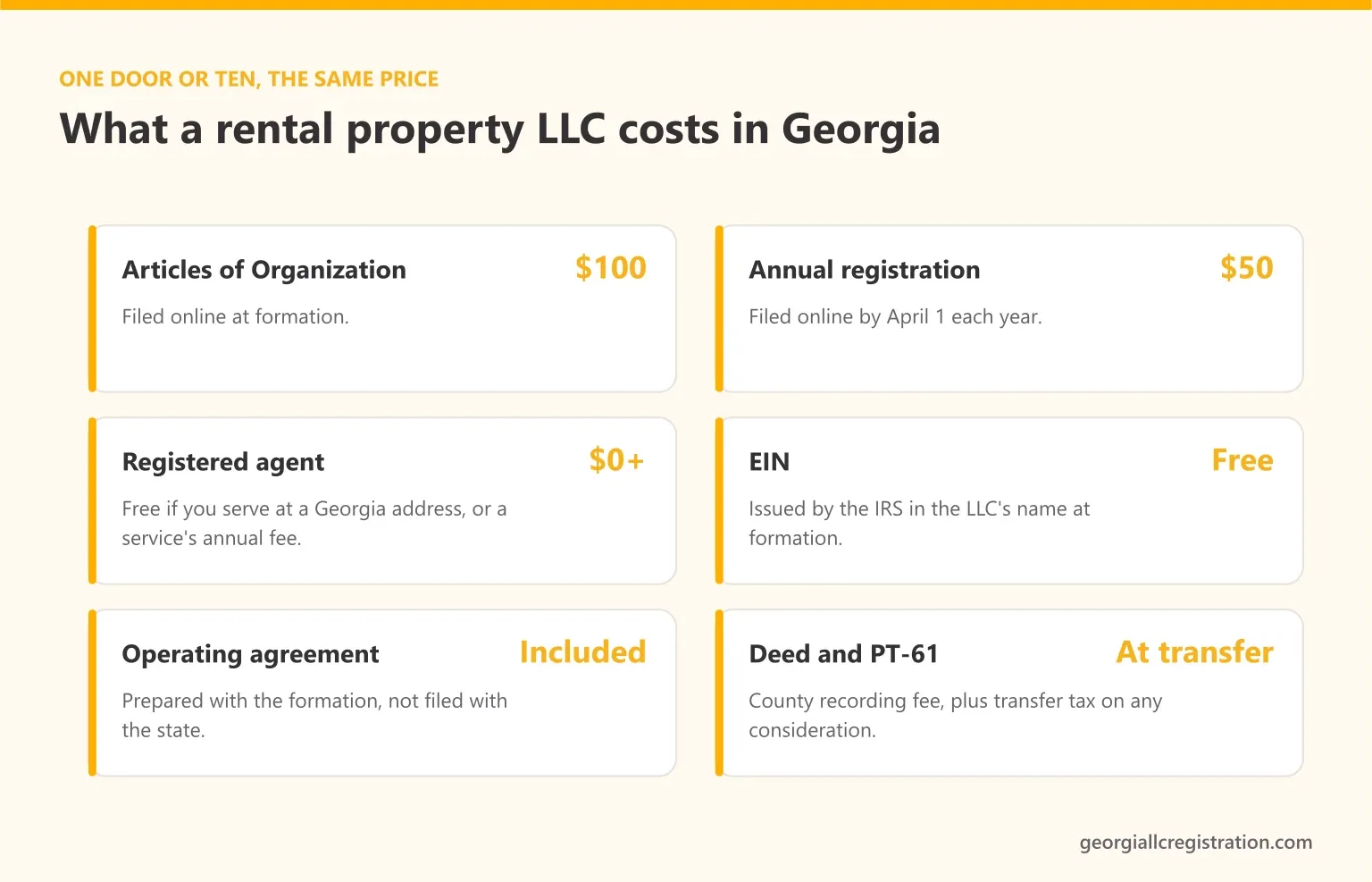
A single LLC for real estate investment holding several properties costs $100 to form and $50 a year. One LLC per rental property multiplies both, and the section on multiple properties below sets out when that is worth paying.
Report Rental Property LLC Taxes Exactly as Before
A rental property LLC changes who is liable, not how your rent is taxed. If you are the only member, the LLC is disregarded for income tax. You report the rent, expenses and depreciation on Schedule E of your own return exactly as before. A multi-member LLC files a partnership return and passes the income to the members. Georgia taxes the income at its flat individual rate. The LLC itself pays no Georgia entity-level income tax unless it elects to be taxed as a corporation, which a rental LLC rarely does.
- Federal: pass-through on Schedule E or a partnership return, with depreciation and expenses unchanged
- Georgia: pass-through at the individual rate, no entity income tax and no net worth tax without a corporate election
- Property tax: assessed on the property as before, but the homestead exemption is lost, because an LLC cannot occupy a home
- Sale: capital gains treatment unchanged, and a 1031 exchange remains available to the LLC
The income and net worth taxes a Georgia LLC pays apply in full only where the LLC elects corporate treatment. If you leave the rental LLC on the default, your tax return looks the same as it did in your own name.
How to Set Up an LLC for Rental Property: Let Our Team Form It and Move the Property In
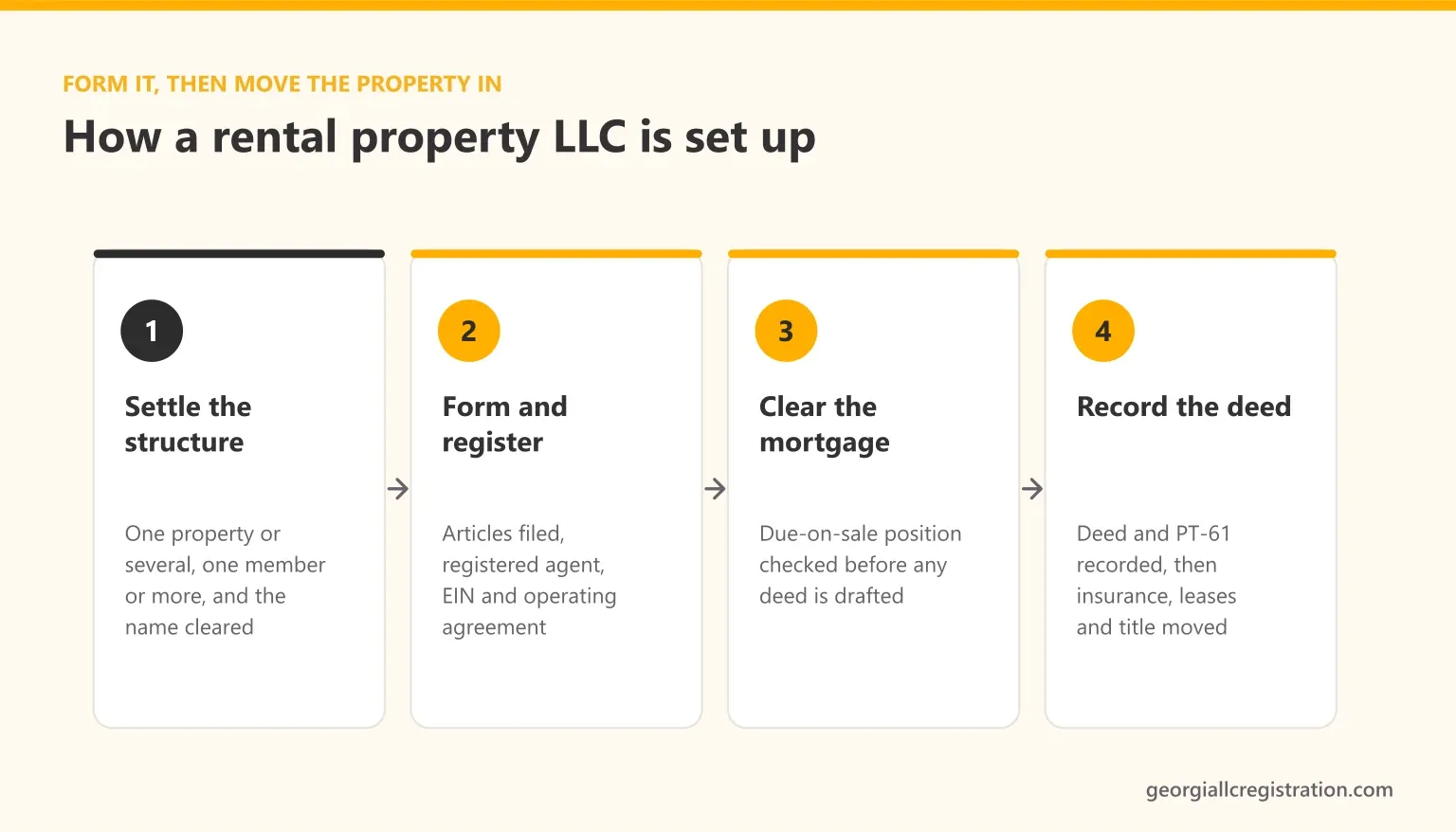
How to start an LLC for rental property has two halves, and how to get an LLC for rental property into working order takes both. The first is forming the LLC, which is the same for any Georgia business. The second is getting the property into it, where the mortgage and the deed decide the sequence. Our team handles both in the four stages below, and you approve each filing before it goes.
Stage 1: Settle the Structure and Clear the Name
Setting up an LLC for a rental property starts with two decisions that shape everything after them. Setting up an LLC for rental properties held together starts with the same two. Will the LLC hold one property or several, and will it have one member or more? The answers decide the operating agreement, the tax return and the number of bank accounts. We then run a Georgia business name search against the LLC register and the trade name register, because a property LLC often trades under the property's street name. Where the formation will not follow at once, we reserve the name.
Stage 2: Form the LLC and Register It
We file the Articles of Organization with the Secretary of State and appoint the registered agent at a Georgia street address. The EIN is obtained from the IRS in the LLC's name. The rental property LLC operating agreement is drafted to the structure agreed in stage one. The agreement sets the capital contributions, the distribution of rent, the authority to sign leases and the process for adding or selling a property. Georgia does not require it to be filed, but your lender and a court will both ask you for it.
- Articles of Organization filed and the certificate of organization received
- Registered agent appointed and the annual registration date set for April 1
- EIN issued to the LLC
- Operating agreement signed by every member
Stage 3: Clear the Mortgage Before Any Deed Is Signed
If you bought the property in your own name with a conventional loan, it carries a due-on-sale clause, and a transfer to an LLC can trigger it. We read your mortgage before any deed is drafted and place it in one of the rows below. Fannie Mae's servicing guide requires the servicer to allow a transfer to an LLC you control or majority-own, where the loan was purchased on or after June 1, 2016. Freddie Mac allows the same transfer after 12 months where you are the managing member. FHA, VA and bank portfolio loans are outside both exemptions.
| Loan type | Transfer to your own LLC | What we do |
|---|---|---|
| Fannie Mae conventional, purchased since June 2016 | Permitted where you control or majority-own the LLC | Notify the servicer with the LLC documents before recording |
| Freddie Mac conventional | Permitted after 12 months where you are the managing member | Notify the servicer after the first year |
| FHA or VA | Not exempt | Obtain written lender consent, or hold the property until refinance |
| Bank portfolio or commercial loan | Depends on the note | Obtain written consent under the loan's transfer clause |
| Property bought by the LLC with an investor loan | No transfer needed | Close in the LLC's name from the start |
Both agencies require the property to be moved back to your own name before a refinance, so where you plan to refinance we time the transfer around that. A rental property LLC mortgage on a purchase the LLC makes itself is a commercial or investor loan, with a larger down payment and your personal guarantee.
Stage 4: Record the Deed and Bring the Records Across
With the mortgage position settled, we transfer rental property to LLC ownership by deed and record it with the PT-61 declaration at the county Superior Court clerk. Georgia's transfer tax is $1 on the first $1,000 of consideration and 10 cents on each $100 after that. A deed into your own LLC for no consideration usually owes none. The recording is the last filing, not the last step, because four records still name you as owner and each has to be brought across.
- Homestead exemption removed and the county assessor notified of the new owner
- Landlord insurance reissued in the LLC's name, with you as additional insured
- Existing leases assigned to the LLC and tenants told where to pay rent
- Title insurance endorsed for the LLC as owner, because your owner's policy may not cover the LLC as the new owner
Rental Property LLC Requirements: Keep the Shield Intact After Formation
The formation and the transfer create the shield. Three ongoing practices keep it, whether you are opening LLC for rental property ownership for the first time or adding to a portfolio.
Open a Rental Property LLC Bank Account and Use Only It
A rental property LLC bank account in the LLC's own name receives every rent payment and pays every expense, and nothing else passes through it. Your bank asks for the certificate of organization, the EIN letter and the operating agreement, and our team supplies you with the set once the formation is complete. Rent paid into your personal account, or a repair paid from it, is the evidence a claimant's lawyer uses to argue the LLC is your alter ego. That argument is how a shield is pierced.
Choose Between One LLC Per Rental Property and One for All
Georgia has no series LLC, so your choice is between one LLC holding every property and a separate LLC for each. One LLC is cheaper and simpler, and a claim on one property reaches the others you hold in it. One LLC per rental property isolates each, at $100 to form and $50 a year for every additional entity, with a separate bank account and lease set for each.
| Structure | Best for | Trade-off |
|---|---|---|
| One LLC for multiple rental properties | Two or three lower-value properties with modest equity | A claim on any one reaches all of them |
| One LLC per rental property | Higher-value properties, or properties with different co-owners | More filings, accounts and returns |
| A holding LLC owning property LLCs | Portfolios of five or more, or investors bringing in partners | Layered agreements and a partnership return at the top |
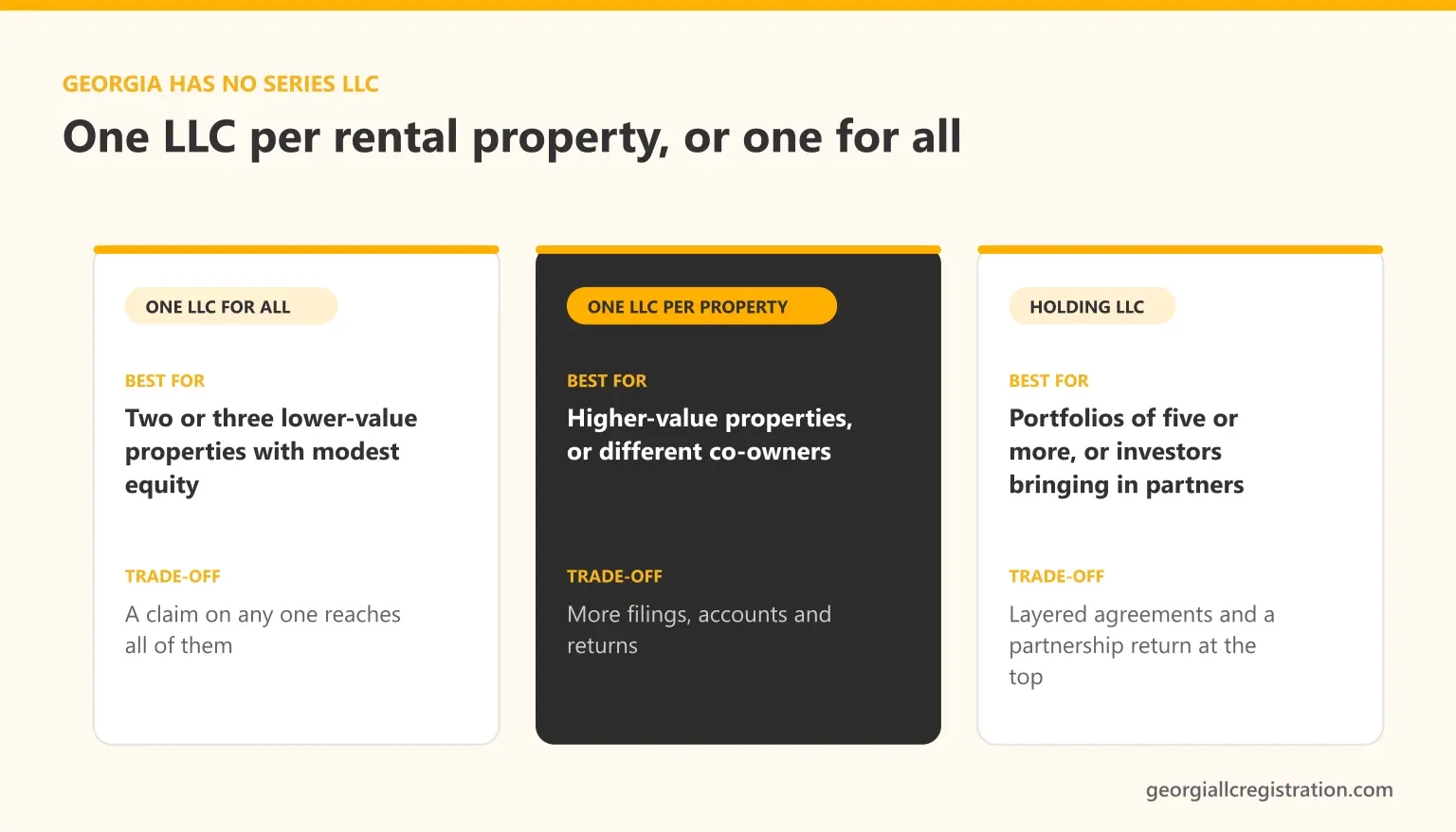
A common middle course is one LLC per property for the higher-value doors and a shared rental property business LLC for the smaller ones. Our team maps your portfolio and the equity in each property before recommending the structure, because the right answer changes with what each LLC would have to lose.
Buy the Next Property Through the LLC
Once the LLC exists, the cleanest route for the next purchase is to close in its name from the outset. Investors who create LLC to buy rental property before the offer, and those who start real estate LLC structures for a portfolio, avoid every question in stage three. The contract, the deed and the loan are all in the LLC, so no transfer, no due-on-sale question and no title endorsement are needed afterwards. The loan is an investor or commercial loan with your guarantee, underwritten on the property's rent and your own credit. You sign for the LLC as its member. Forming an LLC to buy rental property before the offer, rather than after closing, is the right sequence. The same LLC for investment property then holds each later purchase, or a new one is formed for each.
Form the LLC First, Then Time Your Transfer Around the Mortgage
Starting an LLC for rental property is a $100 filing, and creating an LLC for rental property portfolios held in several LLCs is the same filing repeated. Getting your property into it without disturbing the loan, the insurance or the title is the part that needs sequencing.
- The LLC shields your personal assets from claims on the property, provided you keep the accounts separate and follow the agreement
- Georgia costs $100 to form and $50 a year, with the rent taxed exactly as before on your own return
- Your mortgage decides the transfer, and Fannie Mae and Freddie Mac loans can move into an LLC you control while FHA, VA and portfolio loans need consent
- The deed, the PT-61, the insurance, the leases and the title endorsement are handled together at transfer
- One LLC per property isolates risk, one LLC for all saves cost, and Georgia offers no series LLC between them
Tell us the address, how it is financed and whether you plan to add more doors. Georgia LLC Registration, operated by Bestax Accountants, will form the LLC and read the mortgage. We then move the property in with the deed, the insurance and the leases done in the right order.
Book a consultation or contact our team to set up your rental property LLC.
Frequently Asked Questions
Can you make an LLC for rental property you already own and rent out, or only for new purchases?
Both. An existing rental is transferred by deed into the LLC once the mortgage position is cleared, and a new purchase is closed in the LLC's name from the start. The existing rental is the case that needs the lender check, the title endorsement and the lease assignment. The new purchase needs none of them.
Will transferring my rental into an LLC trigger a property tax reassessment in Georgia?
No. Georgia assesses property annually on its value regardless of a change in owner, so the transfer itself does not reset the assessment. What changes is the homestead exemption, which is removed because the LLC cannot claim it. A property that was your former home loses that reduction in the year after transfer.
Does the LLC need its own tax return?
A single-member LLC does not. Its rent and expenses go on Schedule E of your own return, and Georgia follows the federal treatment. A multi-member LLC files a federal partnership return and a Georgia Form 700, and each member reports their share. Neither pays entity-level income tax unless it elects corporate treatment.
Can I keep my existing landlord insurance after the transfer?
Not as it stands. The policy insures you as owner, and after the transfer the owner is the LLC. The policy is reissued or endorsed in the LLC's name, with you added as an additional insured, before the deed is recorded. A claim under a policy that still names you as owner of property you no longer own is the kind of gap a carrier contests.
If I sell the property later, does the LLC complicate the sale?
No. The LLC sells the property by a deed signed by its authorised member. The gain passes through to you on the same terms as a sale in your own name. A buyer's lender and title company ask for the operating agreement and a resolution authorising the sale, which is why the agreement is kept current. A 1031 exchange remains available to the LLC as seller.
Disclaimer: The information provided in this blog is for general informational purposes only. For professional assistance and advice, please contact experts.
