
Table of Contents
Somewhere in Atlanta this week, a process server is knocking on a door that used to be a founder's apartment. The company moved eighteen months ago. Nobody updated the filing, so nobody signs for the envelope, and the lawsuit proceeds without the owner ever hearing about it.
A Georgia registered agent exists to stop precisely that. It is the one job in your formation paperwork that has nothing to do with taxes or profit, and it is the one most owners set once and never look at again.
Skip it for 60 days and the state can dissolve your company under O.C.G.A. 14-11-603. Reinstating costs $250 on the Secretary of State's current fee schedule, which took effect on September 6, 2025. That is a lot of money for a line of text nobody checked.
What is a registered agent in Georgia?
A Georgia registered agent is the person or company officially listed to receive legal and state mail for your LLC. Georgia requires every LLC to name one, keep a Georgia street address on file for them, and keep that information current with the Corporations Division.
What your agent actually receives
The job is narrower than most people assume. Your agent is not your accountant and does not handle your customers. They receive a specific category of mail:
- Service of process. Lawsuits, subpoenas, garnishment orders. The legal reason the role exists.
- State correspondence. Annual registration reminders and compliance notices from the Secretary of State.
- Tax notices. Some state notices route through the registered address rather than your mailing address.
That is roughly it. An agent who promises far more than this is selling you something else with the agent service attached.
Registered agent versus registered office
Georgia treats these as two connected things. The registered agent is who receives the documents. The registered office is where they receive them, and it has to be a physical street address in Georgia. Change one and you usually have to update the other, which is why the state charges for a registered office address change separately from an agent change.
Who can be a registered agent in Georgia?
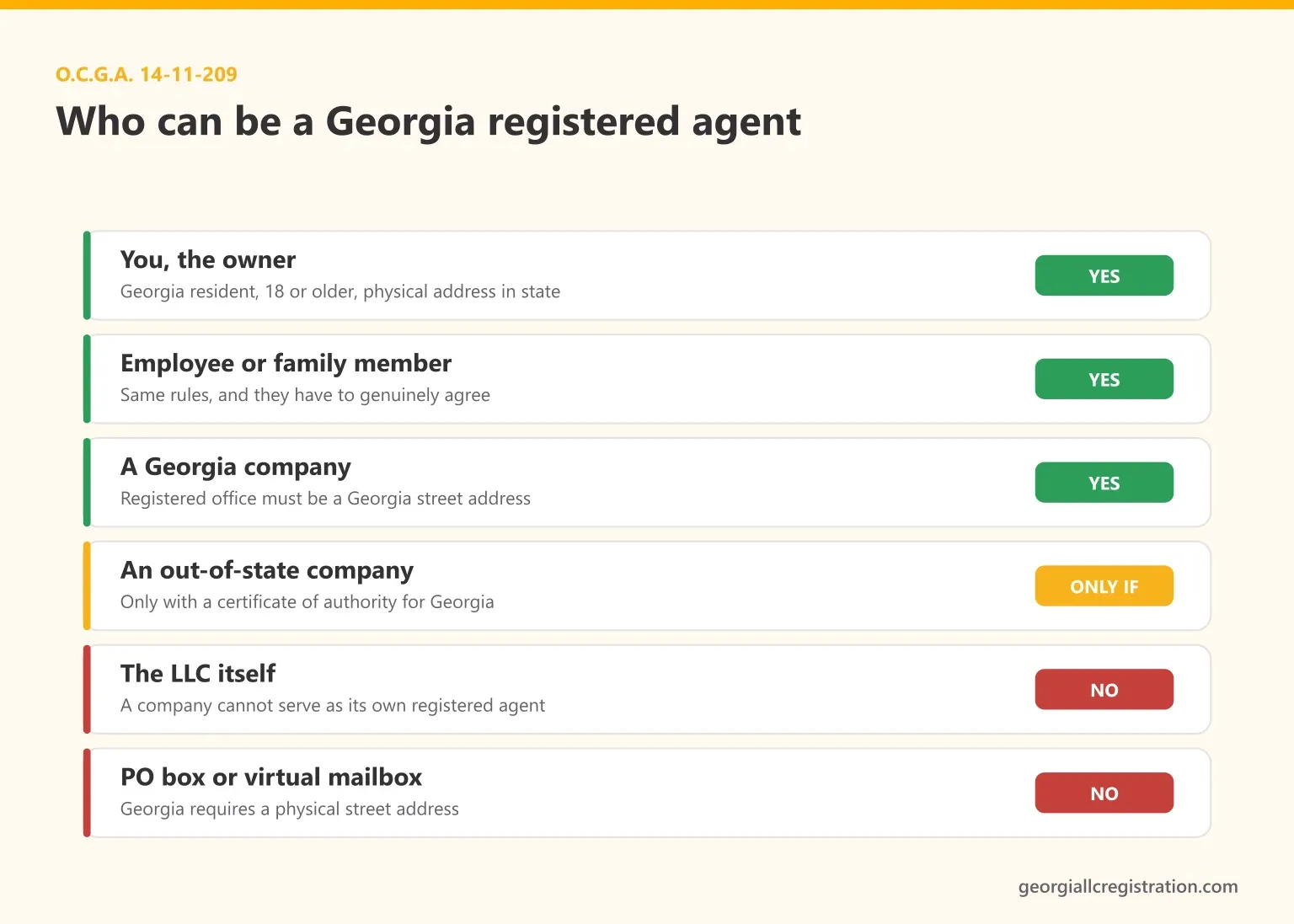
Under O.C.G.A. 14-11-209, a Georgia registered agent can be an individual who lives in Georgia, a Georgia business entity, or an out-of-state entity authorized to transact business in Georgia. Whoever you pick needs a real street address in the state.
| Agent type | Allowed? | What Georgia requires |
|---|---|---|
| You, the owner | Yes | Georgia resident, at least 18, physical address in state |
| An employee or family member | Yes | Same rules, and they must genuinely agree to it |
| Your Georgia LLC or corporation | Yes | Registered office must be a Georgia street address |
| An out-of-state company | Only if authorized | Must hold a certificate of authority to transact business in Georgia |
| The LLC acting as its own agent | No | A company cannot serve as its own registered agent |
| A PO box or mailbox store | No | Georgia requires a physical street address |
The address rule catches people out
No PO boxes. That part is well known. Less well known is that a virtual mailbox usually fails too, because somebody has to be physically present to accept documents handed over in person during business hours. A mail-scanning subscription does not satisfy that.
Availability is the real requirement hiding inside the address rule. An address where nobody stands during the working day is not a registered office, whatever the lease says.
Can you be your own registered agent in Georgia?
Yes. Georgia lets any owner who lives in the state and is over 18 act as their own registered agent, at no cost. The catch is not legal, it is practical: your address becomes public record and you have to be reachable during business hours, every working day.
What it costs you in privacy
Registered agent details are searchable on the state's business database. Use your home address and it sits there, permanently, next to your name. Marketers scrape that database constantly, which is why a new filing tends to be followed by a wave of official-looking mail.
For founders running a business from a spare room, that is often the deciding factor. Not the fee. The fact that a stranger with a grievance can find where you sleep.
When being your own agent stops working
Being your own agent works fine right up until it does not. Four situations reliably break it:
- You move house and forget the filing, which is the single most common way Georgia LLCs lose their agent.
- You travel, or take a holiday, and a process server calls while you are away.
- You live outside Georgia, or outside the United States, in which case you are not eligible at all.
- You would rather not be handed a lawsuit in front of a customer, which is a real consideration for retail and clinic owners.
If you are forming from abroad, this is usually the first thing that forces a decision. Our guide to registering a foreign LLC in Georgia covers the related paperwork for companies formed in another state.
What does a Georgia registered agent cost?
Acting as your own Georgia registered agent is free. A commercial service typically runs between $100 and $300 a year. The state fees sit alongside that and are fixed, published, and the same whichever agent you use.
| Filing | Online fee | Paper surcharge |
|---|---|---|
| Articles of Organization (forming the LLC) | $100 | +$10 |
| Annual registration | $50 | +$10 |
| Amended annual registration (changing agent mid-year) | $20 | +$10 |
| Registered office address change | $5 per entity, $20 minimum | +$10 |
| Registered agent resignation | No fee | $10 |
| Late filing of annual registration | $25 penalty | $25 |
| Application for reinstatement | $250 | +$10 |
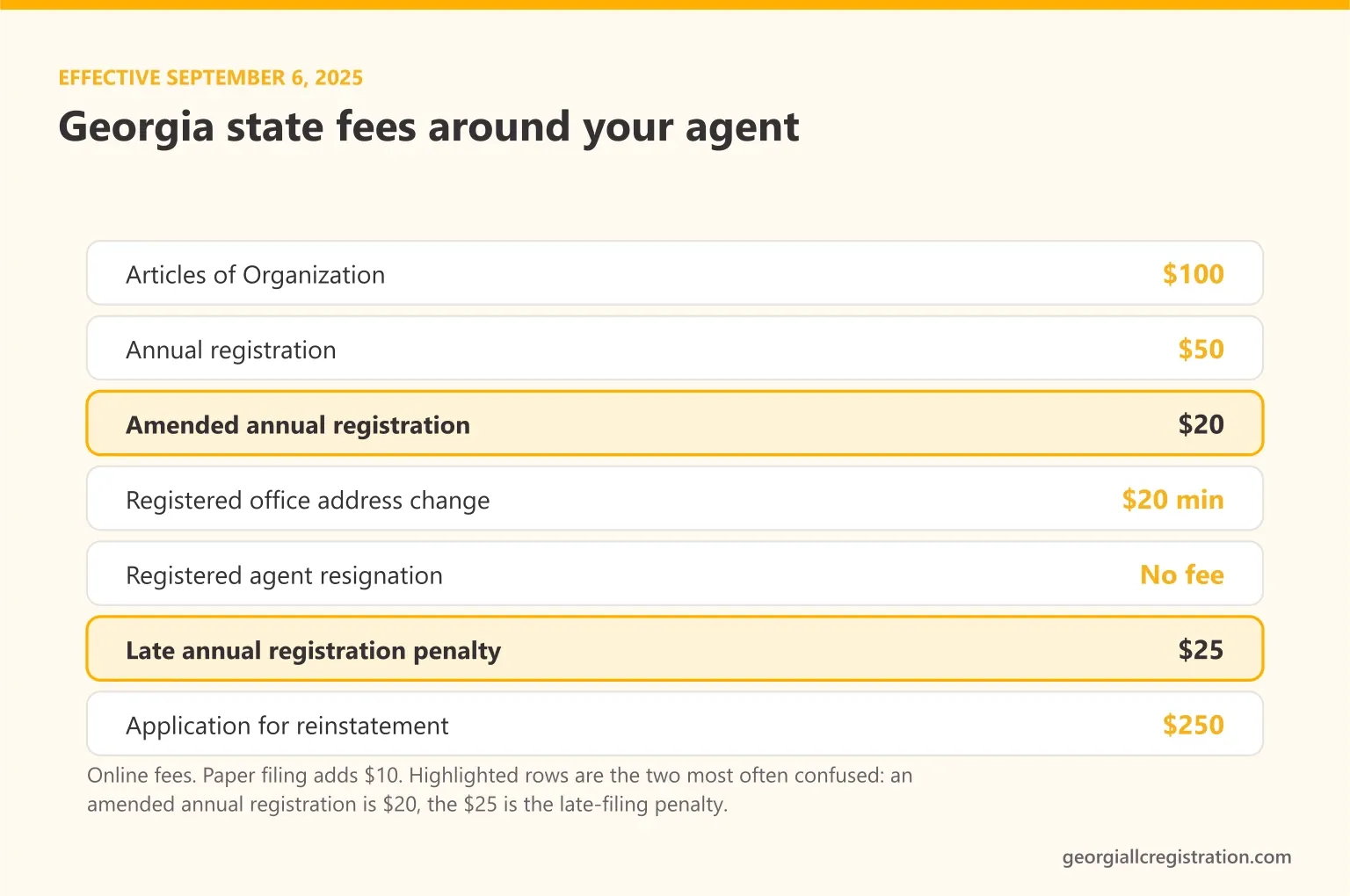
Worth flagging one thing, because several popular guides get it wrong: an amended annual registration is $20, not $25. The $25 figure is the penalty for filing your annual registration late. Two different charges that happen to sit near each other on the official fee schedule.
The annual registration itself is a separate obligation from the agent, though the two are filed together. We cover the deadline and the penalties in more detail in our guide to Georgia LLC taxes.
What happens if your LLC has no registered agent?
Georgia can administratively dissolve your LLC. Under O.C.G.A. 14-11-603, going 60 days or more without a registered agent or registered office is grounds for dissolution. The Secretary of State sends written notice first, then gives you a further 60 days to fix it.
The 60 day clock most guides skip
The sequence matters, because there are two separate 60 day periods and people conflate them:
- Day 0. Your agent resigns, moves, or the address stops being valid.
- Day 60. Grounds for administrative dissolution now exist.
- Notice. The Secretary of State mails written notice to your last known principal office address, or to the registered agent. If that address is the stale one, this is where things go quiet.
- 60 days after notice. You correct the problem or show the grounds do not exist.
- Dissolution. The state signs a certificate of dissolution.
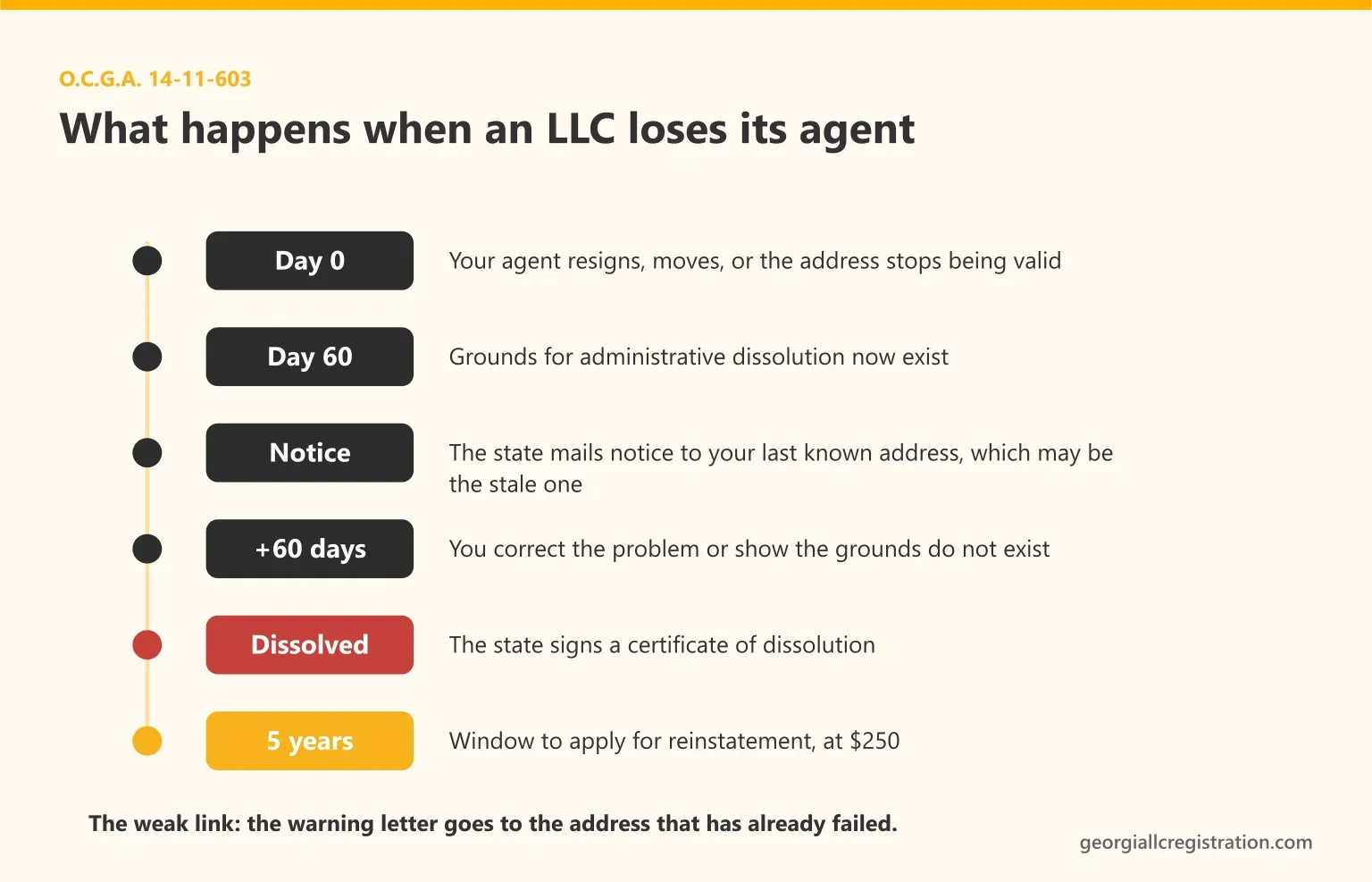
Notice the weak link. The warning goes to the address that has already failed. An owner who moved and forgot the filing is exactly the owner least likely to receive the letter telling them their company is about to be dissolved.
What dissolution actually does
A dissolved LLC does not vanish. It continues to exist, but it may not carry on any business except winding up and liquidating. Banks and payment processors tend to notice quickly, because the state database now shows the entity as dissolved.
You have five years to apply for reinstatement, and it costs $250. There is a second sting: an entity administratively dissolved within the last five years blocks its own name from being reserved, so you cannot simply start a fresh company on the same name while the old one sits there. If you are at the naming stage, our Georgia business name search guide explains how availability is checked.
Default judgments are the quieter risk
Dissolution is the headline, but missed service of process is the one that empties a bank account. If a lawsuit is properly served on your registered agent and nobody responds, the court can enter a default judgment. You lose without ever arguing. Then comes collection, and the first you hear of it may be a frozen account.
How do you change your registered agent in Georgia?
You change a Georgia registered agent through the Secretary of State's eCorp portal. Between January 1 and April 1 you can update the details inside your annual registration at no extra cost. Outside that window, file an amended annual registration for $20.
Changing during annual registration season
The cheapest route is simply timing. Your annual registration is already due between January 1 and April 1, and it already asks for your registered agent details. Update them there and the change costs nothing beyond the $50 you owe anyway.
Changing at any other time
Outside the window you file an amended annual registration through the Corporations Division. It is $20 online. Do not wait for next January if your agent has already gone, because the 60 day clock started the day the arrangement ended, not the day you got around to the paperwork.
When your agent resigns on you
Agents can resign, and it costs them nothing to do so online. A commercial service will usually resign if you stop paying. That is the scenario where an unnoticed lapsed card turns into a dissolved company nine months later, which happens more often than anyone admits.
How should you choose a Georgia registered agent?
Pick on reliability, not price. The difference between a $50 service and a $150 service is rarely the mail handling. It is whether somebody tells you a lawsuit arrived on the day it arrived, and whether the address stays valid when your business moves.
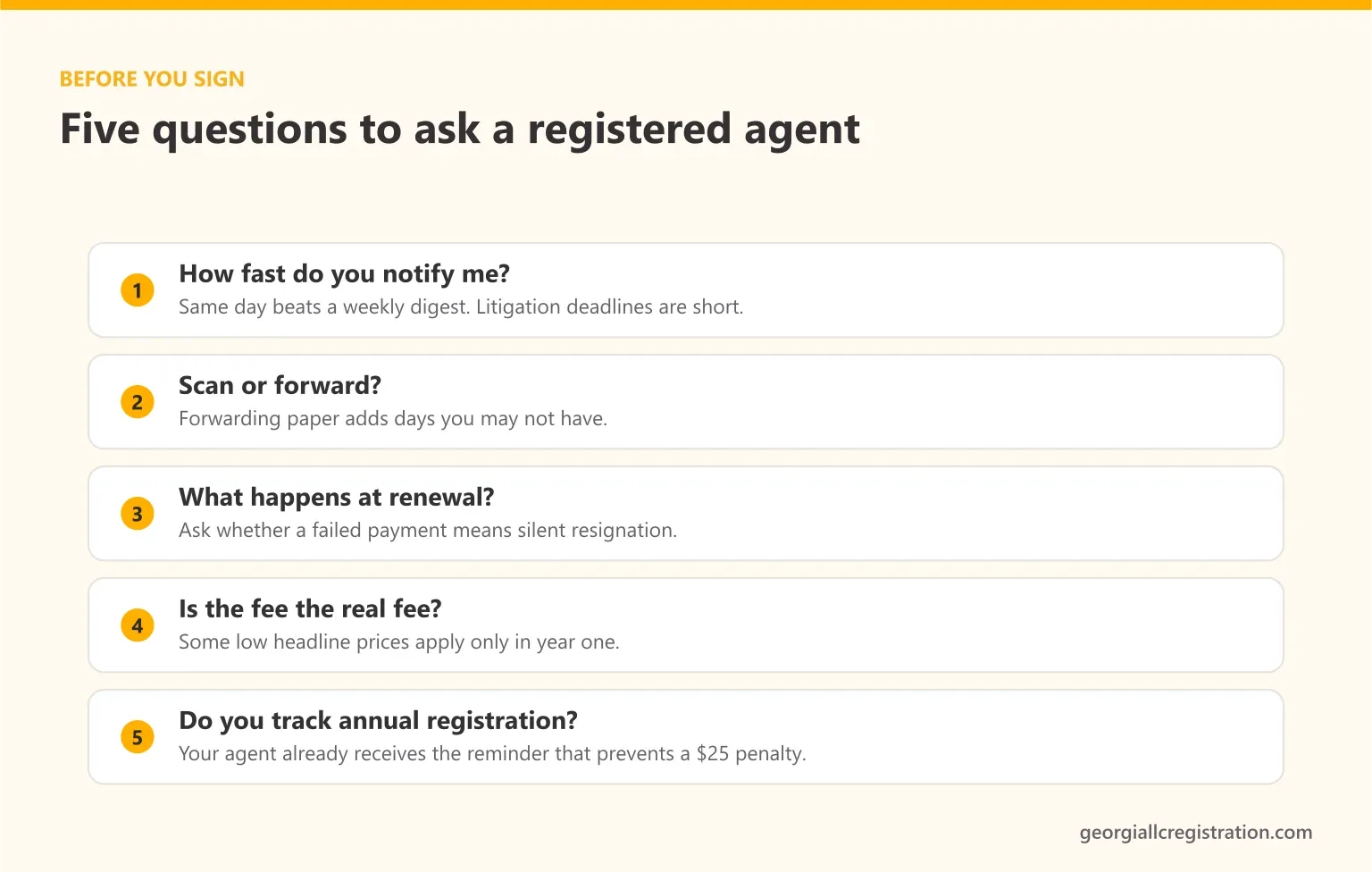
Questions worth asking before you sign
- How fast do you notify me? Same day beats weekly digest. Response deadlines in litigation are short.
- Do you scan everything, or forward paper? Forwarding adds days you may not have.
- What happens at renewal? Ask whether a failed payment means silent resignation.
- Is the fee the real fee? Some low headline prices only apply in year one.
- Will you also track the annual registration? The agent already receives the reminder, so an agent who ignores it is wasting the one piece of mail that prevents a $25 penalty.
Signs of a weak agent
A shared address used by thousands of entities is not automatically bad, but it does mean your documents sit in a large sorting operation. Bigger warnings are an agent who cannot tell you their notification turnaround, or one whose renewal terms are hard to find. Vague answers now become missed deadlines later.
If you are still deciding how to structure the business at all, it is worth reading our comparison of a Georgia LLC versus a sole proprietorship first, since a sole proprietorship has no registered agent requirement to solve.
Get registered agent support for your Georgia LLC
Georgia LLC Registration provides registered agent and Georgia address support as part of formation, so your home address stays off the public database and the state's mail reaches somebody who reads it. We also track your annual registration, which is the filing that quietly protects the agent record.
Forming now? Start with registering an LLC in the state of Georgia, then sort out your EIN and a signed operating agreement. Already trading and just want the agent handled, talk to our team and we will review what is currently on file for you.
Frequently Asked Questions
Is a registered agent required for an LLC in Georgia?
Yes. Every Georgia LLC must continuously maintain a registered agent and a registered office in Georgia. Going 60 days or more without one is grounds for administrative dissolution under O.C.G.A. 14-11-603.
Can I be my own registered agent in Georgia?
Yes, if you are at least 18 and have a physical street address in Georgia where you are available during business hours. Your name and address then appear on the public business database.
Can a registered agent in Georgia be a non-resident?
An individual agent must be a Georgia resident. A company can serve if it is a Georgia entity or an out-of-state entity authorized to transact business in Georgia, and it must keep a Georgia street address.
Can I use a PO box as my registered office in Georgia?
No. Georgia requires a physical street address. A PO box is not accepted, and a virtual mailbox generally fails too, because someone must be present to accept documents delivered in person during business hours.
How much does it cost to change a registered agent in Georgia?
Nothing extra if you update it inside your annual registration between January 1 and April 1. Outside that window an amended annual registration costs $20 online, plus $10 if filed on paper.
What happens if my registered agent resigns?
You must appoint a replacement. The 60 day clock toward administrative dissolution starts when the agent stops serving, not when you notice. Commercial services can resign for non-payment, so watch lapsed cards.
How do I reinstate an administratively dissolved Georgia LLC?
Apply to the Secretary of State within five years of dissolution. The application for reinstatement costs $250 online. You will also need to fix whatever caused it, including appointing a valid registered agent.
Is my registered agent address public in Georgia?
Yes. Registered agent names and registered office addresses are public record and searchable on the state's business database. That is the main reason owners avoid using a home address.
Can my Georgia LLC act as its own registered agent?
No. The LLC cannot be its own agent. You can serve personally as an individual, or appoint another qualifying person or company, but the entity cannot name itself.
