

Table of Contents
A sales tax permit Georgia issues through the Georgia Tax Center is the certificate of registration. That certificate lets a business collect the 4 percent state rate and the local rates on top. The permit is free. Trading without it is not, because every dollar of tax not collected is assessed against the seller. The obligation starts with your first taxable sale in the state or your first $100,000 of sales into it.
If you have formed an LLC to sell goods in Georgia, or you ship into Georgia from another state, the permit is your next filing. The Articles of Organization come first, and the permit follows.
The guide below covers who needs the permit and when, how our team files the application, and what the permit obliges you to do once it is issued.
Sales Tax Permit Georgia: Who Needs One and When
Georgia's sales and use tax applies to retail sales of tangible goods and a short list of services. Two kinds of connection to the state create the requirement to register.
Physical Presence in Georgia
A business with a physical presence in the state registers from the first taxable sale, whatever its revenue. Presence is read broadly.
- An office, store, warehouse or other location in Georgia
- Inventory held in the state, including stock in a third-party or marketplace fulfilment centre
- Employees, agents or contractors working in Georgia
- Temporary presence such as a trade show, fair or pop-up where sales are made
A Georgia LLC with a registered office in the state has physical presence by definition. So does a foreign LLC registered to do business in Georgia. The permit application follows the formation or the foreign registration.
The Economic Nexus Threshold for Remote Sellers
A seller with no physical presence registers once its sales into Georgia pass either threshold in the current or previous calendar year.
| Threshold | Measure | What counts |
|---|---|---|
| $100,000 | Gross revenue from retail sales delivered into Georgia | Direct sales through your own site, including non-taxable sales |
| 200 transactions | Separate retail transactions delivered into Georgia | Each order, whatever its value |
| Either | Exceeding one is enough | Sales made through a marketplace that collects for you are excluded |
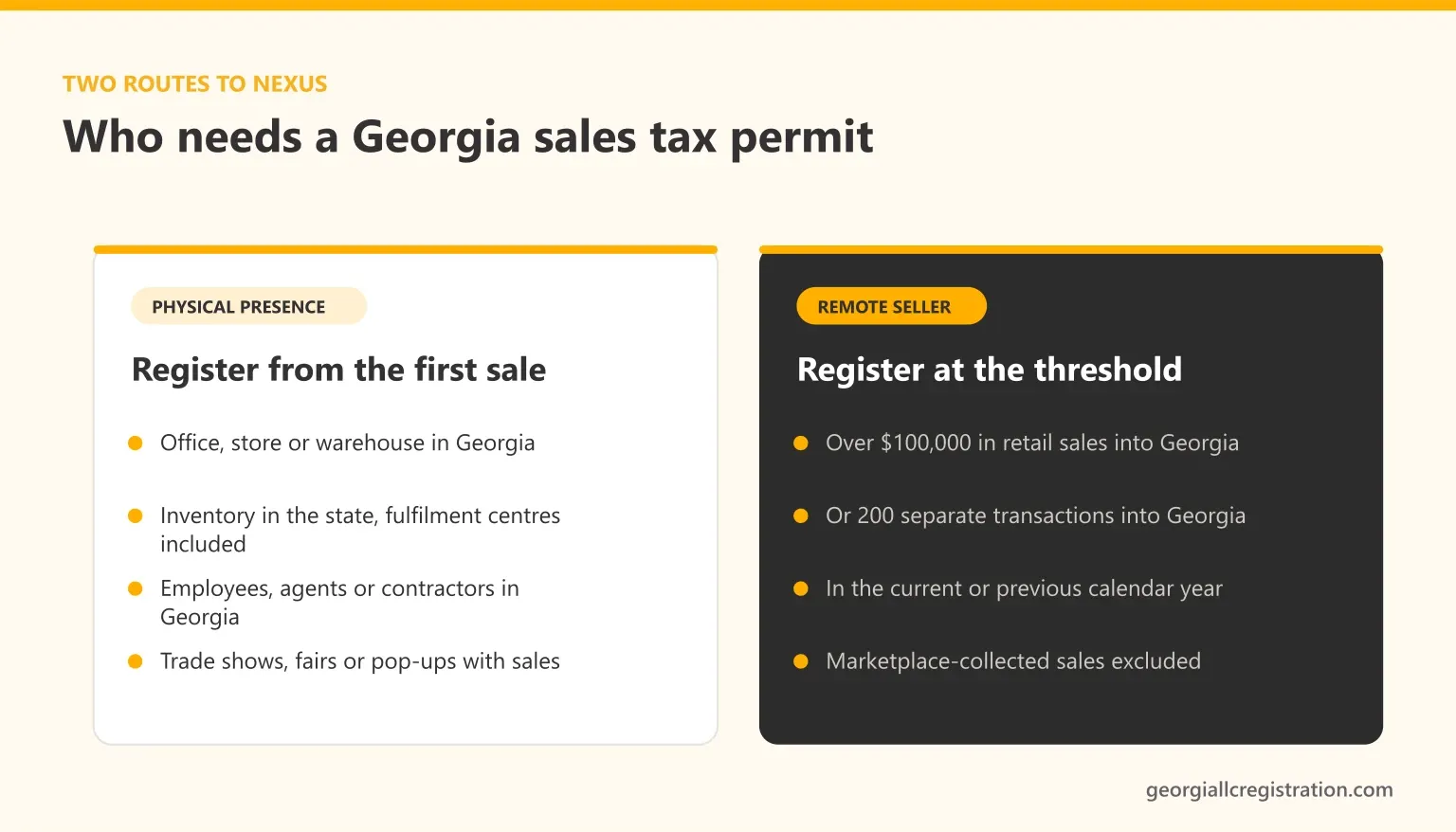
Registration is required on the next transaction after the threshold is crossed. Non-taxable sales delivered into the state count toward it. Marketplace sales collected by the facilitator and sales for resale do not.
What the Permit Is and What It Is Not
The Georgia sales tax permit is the Sales and Use Tax Certificate of Registration, issued with a state taxpayer identification number. The certificate has to be displayed at each business location, and a supplier asks to see it before accepting a Georgia resale certificate, Form ST-5, from you. A Georgia sales and use tax permit is not a business licence, which comes from the city or county. Nor is it your federal EIN, which the application requires you to have first.
Sales Tax Permit Georgia Application: How Our Team Files It
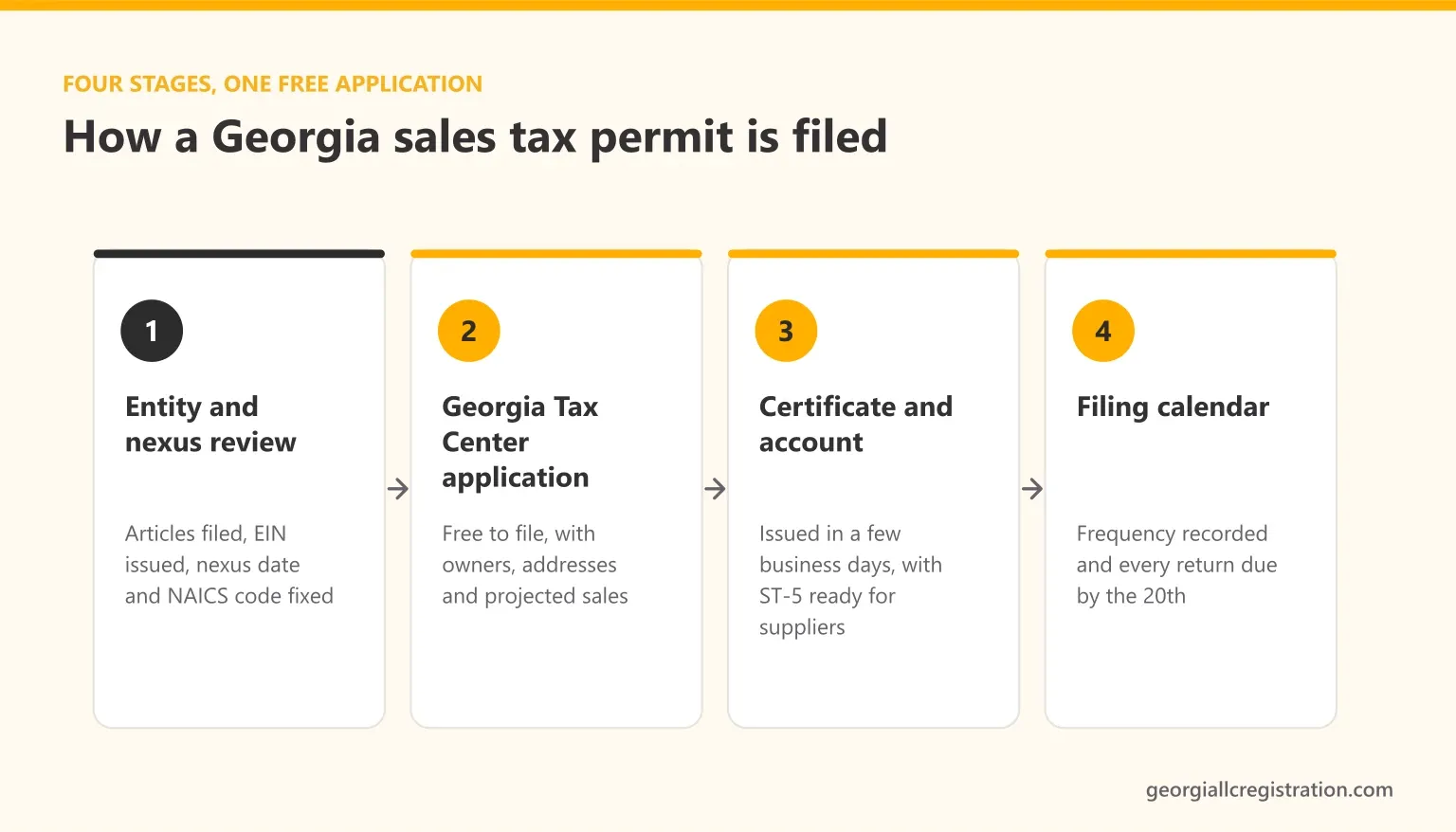
The Georgia sales and use tax permit application is filed online through the Georgia Tax Center, the Department of Revenue's portal for registration, filing and payment. There is no fee. Our team prepares and files it as part of a Georgia LLC formation, or on its own for an existing business, in the four stages below.
Stage One, the Entity and Nexus Review
Before the application, we confirm the entity is ready and the registration is due. The LLC's Articles of Organization have to be filed and the federal EIN issued, because the application asks for both. We then establish which nexus applies, physical or economic, and the date it arose. That date is the date from which tax was due to be collected, and the Department can assess back to it.
- Articles of Organization filed with the Georgia Secretary of State and the control number recorded
- Federal EIN obtained from the IRS
- Nexus date fixed, from the first Georgia location, inventory or sale, or the threshold crossing
- Business activity classified by NAICS code, which sets the tax types the account is opened for
Stage Two, the Georgia Tax Center Application
We open the Georgia Tax Center account in the LLC's name and file the sales and use tax registration from it. The application asks for the legal name and any trade name, the EIN, the business start date in Georgia and the physical and mailing addresses. The form also asks for the owners and officers with their identification, the NAICS code with a description of what is sold, and the expected monthly sales. Where the business will also have employees or sell fuel, alcohol or tobacco, those registrations are added to the same application.
| Information the application requires | Where we take it from |
|---|---|
| Legal name, trade name and EIN | The Articles of Organization and the IRS EIN letter |
| Georgia start date | The nexus review, matched to the first sale or location |
| Business and mailing addresses | The registered office and any Georgia location |
| Owners and officers, with identification | The operating agreement and the members' documents |
| NAICS code and description of goods sold | The business plan, confirmed against the Department's list |
| Estimated monthly taxable sales | Your projection, which sets the initial filing frequency |
The estimate of monthly sales sets the filing frequency the Department assigns. We take it from your projection rather than a placeholder.
Stage Three, the Certificate and the Account
The Department reviews the application and issues the certificate of registration and the sales tax account number, in most cases within a few business days. We download the certificate from the Georgia Tax Center, send it to you for display at each location, and set up the account for filing. Where you will buy goods for resale, we prepare the ST-5 resale certificate to give your suppliers, so purchases for resale are made without tax from the first order.
Stage Four, the Filing Calendar
A sales tax permit in Georgia comes with a return every period, whether or not any tax was collected. We record the assigned frequency, diarise the due dates, and set up the payment method in the Georgia Tax Center.
Sales Tax Permit Georgia Obligations: Filing, Rates and Penalties
A sales and use tax permit Georgia issues is the start of an obligation that runs every month or quarter. Three things decide whether it runs smoothly.
The Rates You Collect
Georgia's state rate is 4 percent. The sales tax is separate from the income and net worth taxes a Georgia LLC pays on its profits. Counties and cities add local option taxes in 1 percent increments. The combined rate a customer pays runs from 6 to 9 percent depending on where the goods are delivered. Georgia sources sales at destination, which means the rate is the one at the delivery address, not at your location. A business shipping across the state collects at as many rates as it has delivery counties, and the return reports them by jurisdiction.
- State rate: 4 percent on all taxable sales
- Local rates: 2 to 5 percent, by county and city of delivery
- Shipping and handling: taxable when tied to a taxable sale, even if separately stated
- Services: exempt unless specifically listed, which most are not
Filing Frequency, Due Dates and the Vendor's Compensation
Returns are filed on Form ST-3 through the Georgia Tax Center on the frequency the Department assigns. Each return and its payment are due on the 20th of the month after the period ends. A December monthly return is due January 20. A quarterly filer's fourth-quarter return is due the same day.
| Frequency | Assigned when | Due date |
|---|---|---|
| Monthly | The default, and for most businesses with regular sales | The 20th of the following month |
| Quarterly | Assigned by the Department for lower tax liability | The 20th of the month after the quarter |
| Annual | Assigned by the Department for the lowest liability | The 20th of January for the prior year |
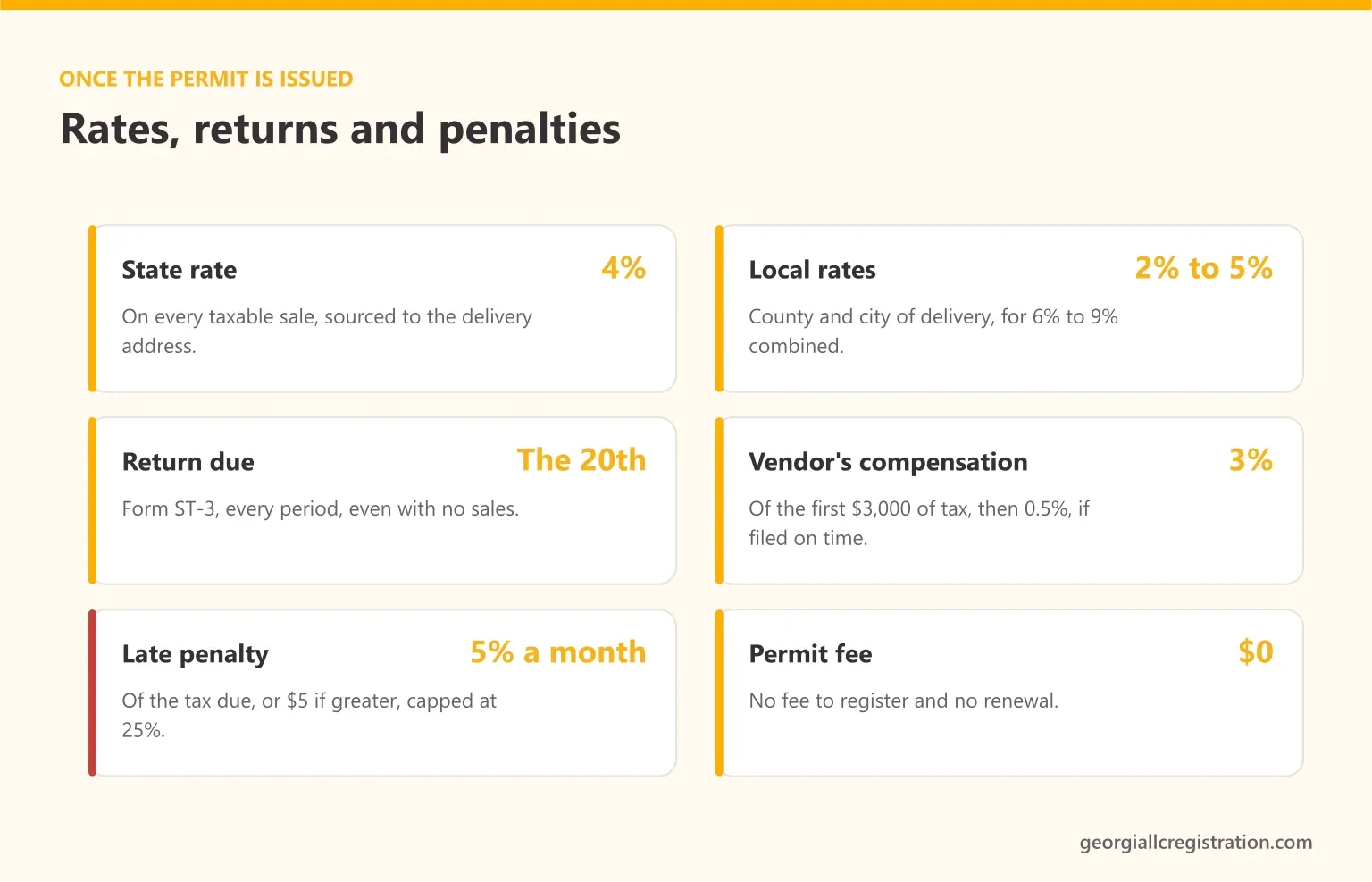
A return filed and paid on time earns a vendor's compensation. That is 3 percent of the first $3,000 of tax due and 0.5 percent of the tax above that, kept by the business as a credit against the payment. A late return forfeits it. Our team files every return inside the due date.
Penalties and the Cost of Trading Without a Permit
A late return or payment carries a penalty of 5 percent of the tax due, or $5 if greater, for each month or part of a month late. The penalty caps at 25 percent. Interest on the unpaid tax runs on top. A business that traded without a permit owes the tax from the nexus date, plus the same penalties and interest. That tax cannot be recovered from customers who were never charged it. The Department's audit program targets unregistered sellers with Georgia inventory or Georgia customers, and marketplace data makes them easy to find.
Where a business has been trading without a permit, we file the registration with the correct start date and prepare the back returns. The exposure is then settled on the Department's terms rather than found on an audit.
Register the Sales Tax Permit Georgia Requires Before the First Sale
The application is one filing, and the timing decides everything.
- A Georgia LLC with a location, inventory or staff in the state registers before its first taxable sale
- A remote seller registers on the next sale after passing $100,000 or 200 transactions into Georgia in the current or previous year
- Our team files the Georgia Tax Center application from the Articles, the EIN and the nexus date, and sets the filing frequency from your real projection
- The certificate is displayed at each location, and the ST-5 is issued to suppliers for purchases made for resale
- Returns go in by the 20th on the assigned frequency, keeping the vendor's compensation and avoiding the 5 percent monthly penalty
Tell us where you will sell and where your stock will sit. Georgia LLC Registration, operated by Bestax Accountants, will file the sales and use tax registration alongside your formation, so the certificate is in hand before your first order ships.
Book a consultation or contact our team to have your Georgia sales tax permit filed.
Frequently Asked Questions
My LLC is registered in another state but I store inventory in a Georgia fulfilment centre. Do I need the permit?
Yes. Inventory held in Georgia, including stock in a third-party or marketplace warehouse, is physical presence, and you register from the first taxable sale regardless of your revenue. If a marketplace collects Georgia tax on those sales for you, the marketplace sales are excluded from your own threshold, but the physical presence still requires the registration.
Does the permit expire or need renewal?
No. The Georgia certificate of registration does not expire and has no renewal fee. The certificate stays valid while the business is active and filing. A business that closes or stops selling in Georgia cancels the registration through the Georgia Tax Center, so returns are not required for periods with no activity.
I sell only services in Georgia. Do I need a sales tax permit?
Usually not. Most services are exempt from Georgia sales tax unless specifically listed, so a pure service business has no sales tax to collect and no permit to hold. A service business that also sells goods, or provides one of the listed taxable services, registers for the goods or the listed service.
How long does the Georgia sales tax registration take?
In most cases the certificate is issued within a few business days of a complete Georgia Tax Center application, and often sooner. The time is in the preparation. An application filed after the Articles are approved and the EIN is issued, with the nexus date and NAICS code settled, is approved without correspondence.
What if I crossed the threshold last year and never registered?
You register now with the correct start date, which is the date you crossed the threshold. Returns are then filed for the periods since, with the tax, penalties and interest. The Department assesses from the nexus date on audit, so registering with an accurate start date and settling the back periods costs less than waiting. Our team prepares the registration and the back returns together.
Disclaimer: The information provided in this blog is for general informational purposes only. For professional assistance and advice, please contact experts.
